
Throughout our history, CyLab researchers have used artificial intelligence to both detect and defend against increasingly sophisticated cyberattacks. Our research teams develop AI-driven systems that can identify vulnerabilities, recognize malicious activity in real time, and automatically respond to threats across networks, software, and connected devices. At the same time, our researchers study how attackers can misuse AI, helping organizations better understand and prepare for emerging risks posed by large language models and other advanced technologies. Through this work, CyLab is helping to shape safer, more trustworthy AI and cybersecurity systems for industry, government, and society.

In 2016, Carnegie Mellon University spinoff ForAllSecure won the $2 million top prize at the DARPA Grand Challenge.
Advancing Research on Automated Attacks
David Brumley founded ForAllSecure in 2012 alongside Carnegie Mellon graduate students Thanassis Avgerinos and Alex Rebert as a spinout from their CMU research. The company grew out of Brumley’s belief that defenders should have the advantage in cybersecurity, leading the team to pioneer research into autonomous systems capable of finding software vulnerabilities before attackers could exploit them. Though the concept was initially met with skepticism from industry constituents, the researchers continued developing a system designed to automate vulnerability discovery, exploit generation, and software patching.
That technology became MAYHEM, an autonomous cybersecurity platform that scans software for bugs, generates exploits to test vulnerabilities, and develops fixes without human intervention. The system gained international attention in 2016 when it won the DARPA Cyber Grand Challenge, a first-of-its-kind competition sponsored by the Defense Advanced Research Projects Agency. Competing against six other finalist teams in Las Vegas, MAYHEM earned first place and a $2 million prize, validating years of groundbreaking research in autonomous cybersecurity.
Following its DARPA victory, ForAllSecure shifted from a research-focused startup toward commercial cybersecurity applications, concentrating on protecting software rather than offensive security work. The company collaborated with technology-driven organizations such as Cloudflare, which utilized MAYHEM for continuous automated testing of production software, and Roblox, which used the platform to test the reliability and security of APIs. Over time, the MAYHEM platform was integrated into thousands of open-source projects.
In 2024, the company rebranded as Mayhem Security to reflect the growing prominence of its AI-driven security platform. And in 2025, it was acquired by Bugcrowd in an effort to accelerate its vision to unite the hacker community and the power of AI into a single, adaptive security solution that continuously and proactively finds and fixes new and known vulnerabilities across the attack surface.
Project links:
- Mayhem Security
- Podcast: The Story of ForAllSecure: From High School Dropout to Cybersecurity Innovation

Spoofing Glasses
Since the 2010s, CyLab researchers have explored how artificial intelligence systems operate in real-world conditions, producing influential demonstrations that revealed both the promise and vulnerabilities of machine learning technologies.
In 2016, CyLab researchers published groundbreaking work showing that facial recognition algorithms could be deceived using nothing more than specially designed paper eyeglasses printed on a standard inkjet printer. Led by Ph.D. student Mahmood Sharif and co-authored by CyLab faculty member Lujo Bauer, the study demonstrated how subtle visual modifications could cause advanced facial recognition systems to misidentify individuals as celebrities such as Russell Crowe or Reese Witherspoon.
The project, presented at the 2016 ACM Computer and Communications Security Conference, showed that neural networks could be vulnerable to “adversarial examples,” inputs intentionally crafted to fool AI systems while appearing relatively harmless to human observers.
The research team developed an iterative process in which a neural network gradually adjusted the color patterns on eyeglass frames until the facial recognition software incorrectly classified the wearer. In some experiments, the team successfully impersonated other individuals, while in others they caused the system to fail to recognize a face entirely.
Rather than undermining AI development, the researchers emphasized that the work was intended to improve the robustness of machine learning systems by exposing weaknesses before malicious actors could exploit them. The study became one of the earliest and most widely recognized demonstrations of practical adversarial attacks against commercial-style facial recognition technology.
Project links:
- Project page: Adversarial Machine Learning
- News story: CyLab researchers spoof state-of-the-art facial recognition algorithms with printable eyeglasses
- Paper: Accessorize to a Crime: Real and Stealthy Attacks on State-of-the-Art Face Recognition

Demonstrating the Efficacy of Autonomous LLM Attacks in the Real World
In 2025, CyLab researchers Lujo Bauer and Vyas Sekar again pushed the boundaries of AI security research with the development of Incalmo, a system showing that large language models could autonomously plan and execute sophisticated cyberattacks against enterprise networks.
Led by Ph.D. student Brian Singer, the project examined whether reasoning-capable LLMs could move beyond simplified cybersecurity exercises and conduct realistic multi-stage attacks with minimal human guidance. By equipping the models with structured abstractions of network attack behavior and delegating lower-level tasks to coordinated software agents, the researchers found that the AI systems could independently orchestrate complex exploitation campaigns.
To test the system, the team recreated the environment associated with the 2017 Equifax data breach, incorporating the same network topology and vulnerabilities documented in public investigations. Within this environment, the LLM autonomously planned and executed the breach sequence, including exploiting vulnerabilities, installing malware, and exfiltrating sensitive data.
The work demonstrated that modern AI systems were capable not only of generating text or code, but also of coordinating strategic offensive operations across enterprise infrastructure. At the same time, the researchers argued that these capabilities could eventually strengthen cybersecurity defenses by enabling organizations to conduct continuous automated security testing.
Related work:
- News story: When LLMs autonomously attack
- Paper: Incalmo: An Autonomous LLM-assisted System for Red Teaming Multi-Host Networks
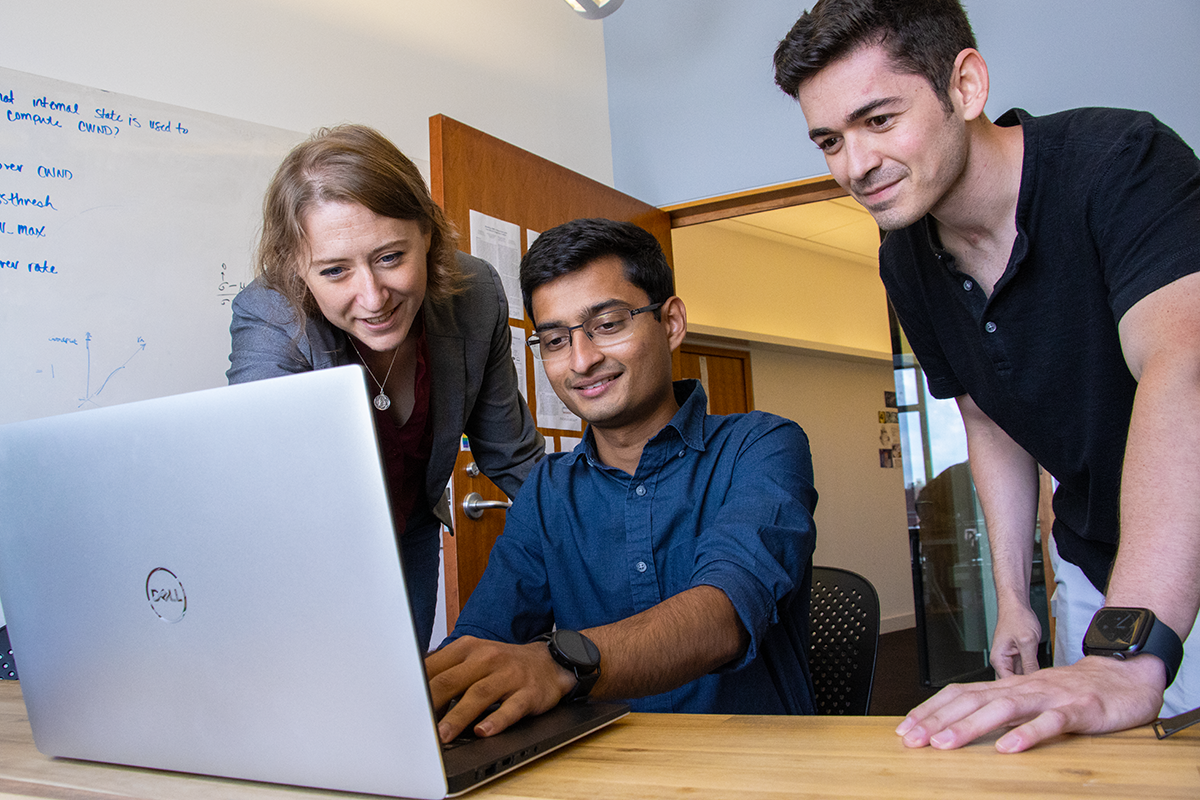
In 2022, CyLab researchers (from left) Justine Sherry, Nirav Atre, and Hugo Sadok developed SurgeProtector, an algorithm designed to predict and deprioritize computationally expensive network packets before they could overwhelm a system.
Enhancing Open-Source Intrusion Detection Systems
In 2022, CyLab faculty members Justine Sherry, Vyas Sekar, and James Hoe developed high-performance systems designed to defend modern networks against increasingly sophisticated cyberattacks. As internet traffic volumes and attack frequency continued to grow, CyLab researchers focused on building scalable cybersecurity tools capable of delivering both speed and resilience without the enormous computing costs associated with traditional security infrastructure.
One of the institute’s most significant achievements was Pigasus, a field-programmable gate array- (FPGA)-accelerated intrusion detection and prevention system developed by Sherry, Sekar, and Hoe. Their work, recognized through Intel’s 2021 Outstanding Researcher Awards, demonstrated how specialized hardware could dramatically improve cybersecurity performance. By shifting much of the processing workload onto an FPGA-based smart network interface card, Pigasus achieved network inspection speeds of 100 gigabits per second using a single server, facilitating performance that would otherwise require hundreds of processor cores in a traditional software-only system.
At the same time, CyLab researchers tackled the growing threat of algorithmic complexity attacks (ACAs), a form of denial-of-service attack that uses small amounts of specially crafted traffic to overwhelm systems. Nirav Atre, a CyLab-affiliated Ph.D. student, developed SurgeProtector, a new algorithm designed to predict and deprioritize computationally expensive network packets before they could overwhelm a system. Working with collaborators including Hugo Sadok, Erica Chiang, Weina Wang, and Sherry, Atre integrated SurgeProtector directly into Pigasus to strengthen its resilience against these attacks.
Together, Pigasus and SurgeProtector demonstrate CyLab’s leadership in developing open-source cybersecurity technologies capable of protecting modern digital infrastructure at scale.
Related work: